Environment
Environmental issues are a priority at Swedavia, and Umeå Airport works continuously in a number of different areas to reduce its environmental impact. In autumn 1999, Umeå Airport was the first airport in Sweden to be environmentally certified.
Swedavia's climate work
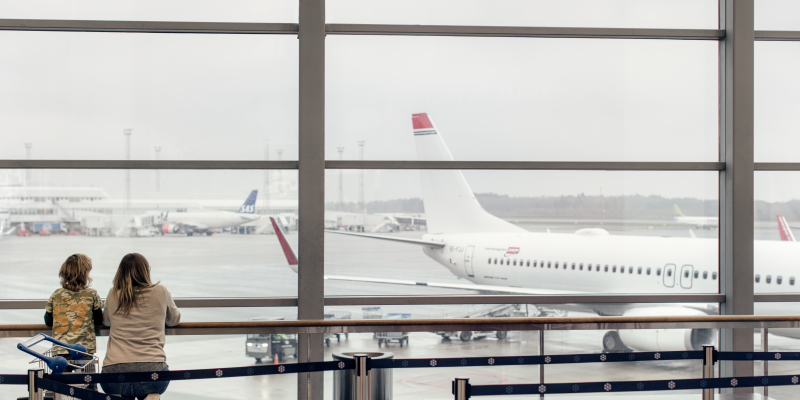
Our zero vision
In 2020, Swedavia achieved the company’s goal of no fossil carbon dioxide emissions from airport operations run under our own management.
Extensive work underpins our success in achieving zero fossil carbon dioxide emissions. We purchase renewable electricity for all our operations, the back-up power supply runs on hydrotreated vegetable oil (HVO100), our vehicle fleet runs on HVO100, fossil-free gas or renewable electricity, and we purchase liquefied petroleum gas (biogasol) and biogas.
At the end of 2025, Swedavia reached its next climate target, as all permanent or recurring actors at the airport use only fossil‑free energy in their airport operations. The work is aligned with the IPCC’s 1.5‑degree scenario and Swedavia’s strategy and goals for a proactive climate transition.
Swedavia’s climate roadmap describes how the company contributes to the climate transition. It covers both the transformation of its own airport operations and the joint efforts with airlines, ground handling companies, suppliers, and authorities. The roadmap shows how measures and collaborations are interconnected and how Swedavia is working step by step to achieve the goal of fossil‑free operations by 2050.
More about the aviation sector’s transition and how Swedavia is working towards fossil free airports
Airport Carbon Accreditation (ACA)
Airport Carbon Accreditation is a framework within Airport Council International (ACI) which evaluates airports' work with handling and reducing their carbon dioxide emissions. The framework has seven levels, where 5 is the highest.
All of Swedavia’s airports are accredited at least at the ACA4+ level in accordance with Airport Council International (ACI) Europe’s standards for the climate work of airports. The next goal is to have all the airports accredited at the ACA5 level, which means that we will increasingly engage and collaborate with other stakeholders with significant carbon emissions at the airports in order to continue reducing emissions together.
Seven of Swedavia's ten airports have been certified at the highest level, ACA5; Stockholm Arlanda Airport, Göteborg Landvetter Airport, Malmö Airport, Åre Östersund Airport, Visby Airport, Ronneby Airport and Kiruna Airport. The three remaining airports – Bromma Stockholm Airport, Luleå Airport and Umeå Airport, will be certified according to ACA5 during 2026.
The airport’s carbon footprint
For greenhouse gas reporting, 2010 has been established as the base year for Scope 1 and 2. For all Scope 3 categories, 2019 has been set as the base year. The different base years have been selected based on the availability of consistent and verifiable data sets, as well as to avoid the effects of the pandemic.
Emissions for the current year (2025) have been calculated using the same organizational boundaries and methods as for the base years to ensure comparability over time. Any recalculations of the base year have been carried out in accordance with ACA guidelines to reflect methodological improvements or structural changes.
Umeå Airport has reduced its Scope 1 and 2 emissions by 417 tonnes of CO₂e, excluding de-icing, which corresponds to a 98 percent reduction compared with 2010. In 2010, Scope 1 and 2 emissions amounted to 427 tonnes of CO₂e, while in 2025 they amounted to 11 tonnes of CO₂e. Including de-icing, Scope 1 and 2 amounted to 646 tonnes of CO₂e in 2010 and 120 tonnes of CO₂e in 2025. A certificate for carbon removal amounting to 121 tonnes of CO₂e (which exceeds the Scope 1 and 2 emissions) is available at Certificate carbon offset removal UME 2025.pdf.
In 2019, Scope 3 emissions amounted to 34 406 tonnes of CO₂e, decreasing to 18 183 tonnes of CO₂e in 2025.
Environmental impact and projects

At Umeå Airport, work is continuously carried out to reduce its environmental impact, and the airport puts great emphasis on working with environmental issues in a structured and systematic way.
The are also a number of environmental projects underway at the airport. You can read about them below.
Electric aircraft
In 2025, a feasibility study on future energy needs will be carried out so that more energy can be ordered for the airport from local energy companies and a plan can be developed for local infrastructure to satisfy future needs for charging points for commercial aircraft.
local energy production
In 2025, a feasibility study will investigate the possibility of local energy production through the establishment of a solar panels in the immediate vicinity of the airport, with the aim of meeting future needs for electric charging points for commercial aircraft and vehicular traffic.
FFFLY
Swedavia and Umeå Airport have been partners in the Municipality of Umeå’s fossil-free aviation project FFFLY. The project has involved analyses and preparation of an action plan for how air transport to and from Umeå can be made fossil-free using sustainable aviation fuel (SAF), electric aircraft, hydrogen gas and electrofuels. Swedavia, through John Nilsson, has been responsible for Work Package 2, dealing with electric aircraft, in which we looked at the possibilities and needs for establishing charging infrastructure for electric aircraft at Umeå Airport.
FLYH2UME
FLYH2UME is a collaborative project between Umeå Municipality, Umeå Energi, RISE, and Swedavia AB. The hydrogen project aims for Swedavia AB, through Umeå Airport, to serve as a model for medium-sized and small airports regarding which infrastructural preparations and infrastructural investments need to be carried out locally at the airport, so that in the near future the airport will be able to handle hydrogen safely, both within a depot/storage area and during the refueling process of aircraft.
Climate roadmap
Umeå Airport has signed onto the Municipality of Umeå’s climate roadmap and, among other moves, has become involved in the strategic group for communication and transport.
Read more here (in Swedish).
Bicycle Garage
Umeå Airport is making strong efforts to ensure that transport to and from the airport is as environmentally friendly as possible. In the spring of 2013, Umeå Airport opened its bicycle garage, much to the delight of travelers who prefer to cycle to their flights. In 2024, the airport also added a parking area for e-scooters next to the bicycle garage.
PFAS
Perfluorinated substances (PFAS) have been used in firefighting foam at Umeå Airport. The airport has carried out several investigations to understand the contamination situation and is actively working on the issue, with the goal of reducing the amount of PFAS from the airport. To monitor the status of the Ume River, the airport is a member of the Ume and Vindel Rivers Water Conservation Association for coordinated recipient monitoring and control.
Environmental management system
Certification entails not just satisfying the requirements of environmental authorities but also meeting the general environmental goals and specific environmental targets set for Umeå Airport.
Both internal and external environmental audits are conducted at the airport. The aim of these audits is to verify that the environmental management system is being used and is both sufficient and effective. Continuous improvement work is under way, entailing more rigorous requirements, which means that each year there are also more stringent environmental goals and targets.
Environmental reports
Environmental report 2025 (pdf, in Swedish)
Appendix 1 – Water (pdf, in Swedish)
Appendix 2 - Waste (pdf, in Swedish)
Appendix 3 – Drinking water (pdf, in Swedish)
Appendix 4 – Flight density plot (pdf, in Swedish)
Purpose and objectives
Swedavia owns, operates and develops airports and properties near these airports in Sweden. We strive to continuously improve our management system (ISO 14001) to minimize our environmental impact and use resources in a sustainable manner throughout the value chain. This is done primarily by reducing greenhouse gas emissions, where we shall maintain at least 90 percents emissions reductions in Scope 1 and 2 and reach net zero in Scope 3 by 2050 at the latest, aligned to applicable net zero frameworks.
We shall also minimize other atmospheric emissions and discharges to soil and water and minimize the use of harmful chemicals. Through systematic work with climate analyses, we adapt to the changing climate. Swedavia shall promote biological diversity, secure effective management of resources in order to contribute to circular economy, and continuously work to improve energy efficiency.
For us, it is a given that we comply with environmental and energy statutes in effect as well as other applicable national and international regulations and requirements. It is also a given that we ensure access to the information and resources required to achieve our environmental and energy objectives and targets. We shall also work to limit aircraft noise and emissions from aircraft operations.
In order to achieve this, working in accordance with the following fundamental rules is required:
- Environmental concern is integral to every part of operations and is taken into consideration in every decision.
- The most important environmental issue for the aviation and real estate sectors is their climate impact, and this must be given priority in decisions and activities.
- We shall continuously improve energy efficiency and manage our own operations as well as influence other companies and organizations that we interact with for the sustainable use of resources.
- We shall purchase energy-efficient products and services and promote construction that leads to better energy performance.
- All of Swedavia´s employees shall take part in our environmental and energy work.
- We shall assess and manage environmental risks and energy performance in a systematic manner.
- Swedavia shall take an active part in local, regional, national and international work in order to reduce the aviation industry´s negative impact on the environment and work for the sustainable development of airports
Track flights
One public tool available for use is Flightradar24.com.
The Webtrak tool that we previously made available here on our website is being reviewed, and we are exploring the possibilities of using other data sources. This is in order to once again enable people living in the vicinity of our airports to track air traffic movements and link this information to aviation noise measurements where available.